We have heard a lot about web 3. I used to think of web 3 as just a new phase of web development, with the assistance of technologies such as Blockchain, thereby making information more distributed and more transparent. Yet, Chris Dixon (a venture capitalist in the crypto space) provides a better definition of web 3 in his book, “Read Write Own: Building the next era of the internet”; Chris explains that web 1 = read, web 2 = read and write, and web 3 = read, write, and own. In other owrds, what differentiate web 3 from the previous internet era is that the web 3 era facilitates ownership (all the stakeholder – including not just the internet companies, but the developers, the content creators, and even the early adoptors, can own a piece of the web 3 development), thereby incentivizing internet innovations rather than suppressing.
Here is the link to the book on Amazon if you want to know more: LINK.
Youtube, Instagram, and web 2
Chris illustrates web 2 with the case of Youtube or Instagram. Imagine you are an Instagram influencer, you put all your time and energy into creating content on Instagram, and you have grown your number of following to tens of thousands, even into the millions. Great, you may have able to monetize your efforts in a number of ways, such as advertising, or sell goods to your followers. However, what is perhaps less talked about is that when you – as an Instagram influence — generate revenue on Instagram, Meta (parent company of Instagram) will take a big cut of such revenue generation. According to ProTunes One, Creators enrolled in the YouTube Partner Program (YPP) earn 55% of the revenue generated from ads on a video. In other words, 45% of ad revenue generated by content creators are taken by Youtube, and I believe this percentage number would be even higher for platforms like Instagram. Does it incentive creation and innovations when a majority of the revenue generated is taken by the platform, instead of going directly to the pockets of content creators? Perhaps not. Why is it okay for platform companies like Instagram to charge such as high fee rate? Because Instagram owns everything on the platform, including your instragram account and your followers. You cannot simply move your Instagram account (along with your follower base) elsewhere; in additional, Instagram can shut down your account anytime when you are considered to violate their user policies. Long story short, ownership goes to a few giant internet platforms in the web 2 era, thereby suppressing – rather than incentivizing – innovations.
S-curve
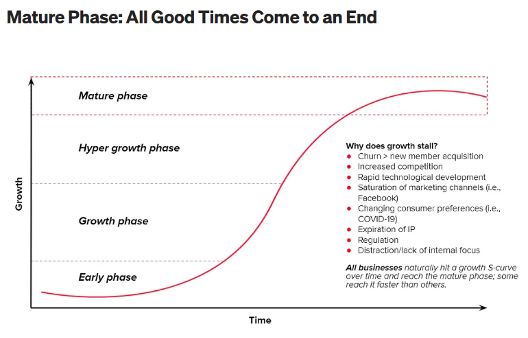
Business development typically follows the “S curve”. The S-curve, also known as the sigmoid curve, is a model used to represent the growth of a business or project over time. It typically shows an initial period of slow growth, followed by a period of rapid acceleration, and then a leveling off as the business or project reaches maturity. The period of acceleration typically sees strong revenue growth, with businesses focusing on user incentivization and the growth of its user base / ecosystem. Meanwhile, growth flatten when businesses focus on monetization, sacrificing stakeholder incentivization and user experience.
Source: Medium (LINK)
How web 3 enables ownership?
Blockhain is one of the key technologies in the web 3 era: Web3 achieves distributed ownership through blockchain technology and decentralized protocols, empowering users with control over their digital assets, data, and identities. Unlike Web2’s centralized systems, where a few entities control data and access, Web3 distributes control across a network, allowing users to own, manage, and transfer their digital assets directly. By allowing all the stakeholder to own a piece of the development through digital tokens, web 3 incentivize innovations, rather than suppressing it.
 Books Bucks & Beyond
Leave a comment