A Reflective Review of Peter Frankopan’s “The Silk Roads: A New History of the World”
The Silk Roads Matter — Now More Than Ever
What if the world’s center was never where we thought? For a long time, history has focused on the West. But maybe the real story — the one behind today’s issues with globalization, changing world powers, and cultural exchange — has always followed a different route: the Silk Roads.
Peter Frankopan’s The Silk Roads: A New History of the World does more than retell history; it reshapes our view. By exploring the ancient paths that linked East and West, Frankopan shows us that the movement of people, goods, ideas, and religions that once shaped empires still influences today’s world. In 2025, his ideas feel especially relevant, touching on everything from supply chain issues and global politics to technology and cultural interactions. This history challenges us to rethink how we understand our place in the world.
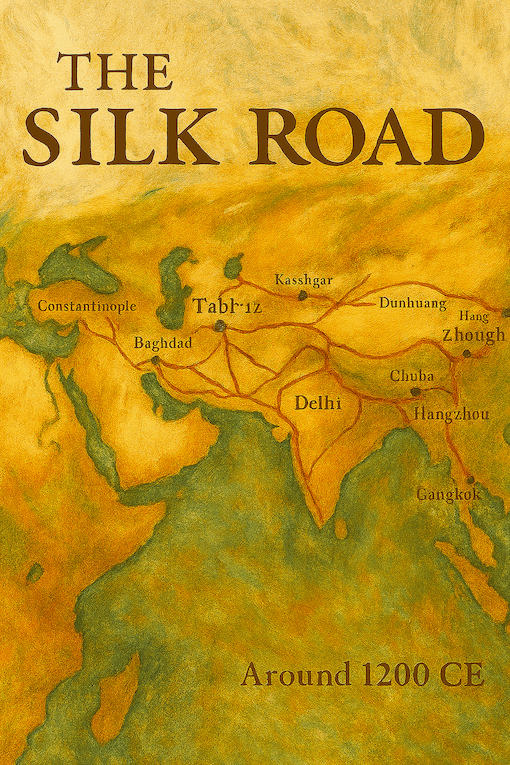
Shifting the Lens: A World History from the Center
From page one, Frankopan issues a challenge: what if we recalibrated our vantage, placing the lands between the Mediterranean and the Pacific — not Europe or North America — at history’s core?
Instead of a “triumph of the West” narrative, The Silk Roads is an odyssey through the arteries of Central Asia, the Middle East, Persia, India, and China. These are the regions that, for millennia, formed the crux of global commerce and intellectual encounter. Frankopan artfully demonstrates:
- The “heart of the world” has always been mobile, depending as much on climate shifts, technology, and empire as on geography.
- Innovation — whether in mathematics, medicine, or philosophy — often surged along vectors running from East to West, not merely the other way around.
- Major world-historical events (the Black Death, the Mongol invasions, the Crusades) originated or converged along these highways of exchange.
In doing so, he upends conventional stories and foregrounds a truly interconnected human saga — one that makes our modern world less the outcome of a Western crescendo, and more the latest phase in a centuries-old web of entanglement.
The Fabric of Connectivity: Trade, Ideas, and Conflict across the Silk Roads
To understand the enduring legacy of the Silk Roads, Frankopan unpacks the fusion of commerce, confrontation, and culture that shaped societies for centuries. Three major themes emerge:
Commerce as Engine and Glue
Trade was more than economic exchange; it forged power, shaped societies, and even identities. The pursuit of silk, spices, silver, and furs spurred exploration, urbanization, and warfare. Empires thrived — or collapsed — on their ability to control trans‑Eurasian trade, while crossroads cities like Samarkand and Baghdad flourished
Exchange of Faiths, Ideas, and Technologies
Along these same routes, religions and ideas travelled: Buddhism from India to China, Islam across a vast trading world, and Christianity, Judaism, and Zoroastrianism through encounters and translations. Algebra, medical texts, paper, gunpowder, and printing all moved westward, reshaping Europe. The Silk Roads carried not just goods, but the very frameworks of culture and knowledge.
Conquest, Migration, and Upheaval
If the Silk Roads were a stage for prosperity, they were equally corridors of devastation:
- Frankopan’s drama includes the Mongols, whose conquests both destroyed and knitted together an unprecedented Eurasian world, facilitating the movement of people, money, and disease (notably the Black Death).
- Colonial expansion into the Silk Route regions ignited contests for resources and territory, laying groundwork for today’s geopolitical flashpoints.
Connecting Past and Present — A Silk Road for the 21st Century
Frankopan’s narrative, while sweeping, poses an urgent question for readers in our own era: What does it mean to live in a world that is, once again, defined by connection, competition, and cultural mingling along new “silk roads”?
Several threads run between then and now:
Globalization Isn’t New — But Its Shape Keeps Changing
By centering Eurasia instead of Western Europe, Frankopan reminds us that the “rise of the East” is not a historical anomaly. Instead, it is a return of the world to older patterns of linkage and influence — patterns that are being re-articulated by the digital highways, energy pipelines, and data flows of the present day.
Power, Adaptation, and Vulnerability
History along the Silk Roads is marked by cycles of resilience and disaster — cities and empires flourish, only to be swept by climate change, war, or plague. In an era marked by COVID-19, climate traumas, and economic shocks pinging across the globe, Frankopan’s narrative feels chillingly prescient. His work gently prods us to ask:
- Are our present supply chains and knowledge networks robust, or fragile?
- How can societies remain open and creative, yet avoid the pitfalls of hegemonic overreach or exclusion?
Cultural Exchange: Contention and Synthesis
Frankopan’s Silk Roads were never one-way streets. They hosted cosmopolitan cities, syncretic philosophies, and explosive clashes of ideas. In pre-modern Samarkand or Baghdad, Jewish, Christian, Buddhist, Muslim, and Hindu traders lived side by side — sometimes harmoniously, sometimes in sharp tension. Today’s multicultural cities, debates over migration, and global cultural phenomena reprise these same, unresolved questions: How do societies balance the richness of exchange with the desire for stability and identity?
Frankopan’s Craft: Structure, Voice, and the Joy of Historical Surprise
Frankopan’s style is both analytical and inviting, often drawing readers into the narrative by encouraging them to “walk the roads” alongside historical figures. He avoids dense jargon in favour of vivid portraits — merchants, conquerors, pilgrims, and diplomats — striking a balance between scholarly depth and accessibility for the curious general reader. The book’s thoughtful structure, with each chapter unveiling a new aspect of Silk Road history, ensures a digestible pace that allows readers to engage with key themes at their leisure. Stories and direct quotes are woven throughout, illuminating the text with first-person perspectives and echoes of contemporary relevance; for instance, when reflecting on the lessons of openness versus restriction, Frankopan observes: “There is a lesson here for the present: those who embrace openness — usually — prosper; those who demand walls, taxes and restrictions — usually — suffer.”
The Takeaway: A Book for Our Moment — And Yours
The Silk Roads is not simply a retelling of “old world” history. It is a reminder that our present interconnectedness, challenges, and opportunities are rooted in thousands of years of exchange, ambition, curiosity, and conflict.
Today, information moves as quickly as goods once did. “Digital Silk Roads” are now crafted through fiber-optic cables, fifth-generation wireless networks, and cross-continental data agreements. Frankopan, writing in 2015, foresaw such transformations:
“The most important flows the world has ever seen may not be physical at all.”
In an age defined by both hyperconnection and fragmentation, this book provides a roadmap — both literal and metaphorical — for approaching global problems with historical perspective and humility.
Frankopan offers a final provocation:
“The Silk Roads have always been a place of movement, ideas, goods — and of people… The future will be as turbulent and as thrilling as the past has been. The question is, how well are we prepared to take one more step along the road?”
I’d love to hear your thoughts — whether you’ve walked the streets of Samarkand, studied the Mongols, or simply wondered how our world became so interconnected. Share your reflections below.
 Books Bucks & Beyond
Leave a comment