🏪 The Day I Realized I Was Already an Investor
I was standing in line at my favorite coffee chain when it hit me: I’d been a loyal customer for years, recommending it to friends, watching new branches pop up across the city. Yet I’d never thought about owning a piece of it.
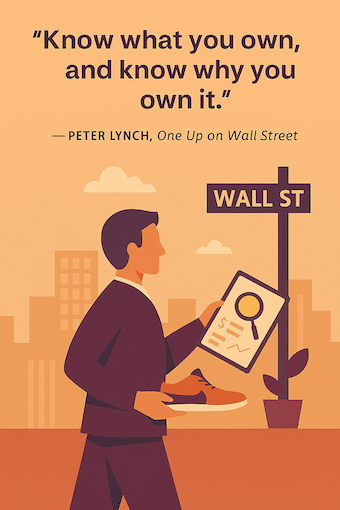
Reading Peter Lynch’s One Up on Wall Street made me see that everyday choices — the brands we trust, the products we buy, the services we rave about — are often the earliest clues to great investments. Lynch’s core message is simple but powerful: you already know more than you think about the stock market.
📚 A Classic That Still Speaks to Beginners
Published in 1989, One Up on Wall Street became one of the most influential investing books of its era. Lynch, who managed Fidelity’s Magellan Fund from 1977 to 1990, delivered an average annual return of 29.2% — more than double the S&P 500 at the time.
What makes the book timeless is its accessibility. Lynch doesn’t drown you in jargon or complex formulas. Instead, he invites you to look at the world around you and recognize that your consumer and professional experiences can give you an edge over Wall Street analysts.
🔍 Lesson 1: Invest in What You Know — Your Everyday Advantage
Lynch’s most famous principle is deceptively simple: start with what you understand.
If you’re a nurse, you might spot promising healthcare companies before they hit mainstream headlines. If you’re a gamer, you might notice a breakout title or hardware trend before analysts do.
Lynch shares stories of investors who spotted winners early because they paid attention to their own lives — like buying shares in a retailer they loved before it expanded nationally.
When I applied this lens, I realized I’d missed opportunities in companies whose products I used daily. The lesson isn’t to buy every brand you like, but to use familiarity as a starting point for deeper research.
📊 Lesson 2: Do Your Homework — The Power of Research
Liking a product is not enough. Lynch emphasizes thorough research before investing:
- Read annual reports and quarterly earnings.
- Understand how the company makes money.
- Look at debt levels, profit margins, and growth potential.
For beginners, this can sound intimidating, but Lynch breaks it down into manageable steps. He even categorizes stocks into six types — slow growers, stalwarts, fast growers, cyclicals, turnarounds, and asset plays — so you can match your expectations to the company’s profile.
When I first tried this, I picked a “stalwart” — a large, stable company — and tracked its performance over a year. The process taught me patience and discipline, even when the stock price dipped.

⏳ Lesson 3: Think Long Term — Let Compounding Work for You
Lynch is a strong advocate for holding good companies for years, allowing compounding to do its magic. He warns against chasing quick wins or reacting to short‑term market noise.
One of his examples: if you’d invested in a growing retailer early and held for a decade, the returns could be life‑changing — but only if you resisted the urge to sell during temporary downturns.
This resonated with me because I’d sold stocks too soon in the past, missing out on gains. Lynch’s reminder is clear: the market rewards patience.
🚫 Lesson 4: Ignore the Macro Noise
Lynch famously admitted he had no idea where “the market” was going in the short term. He didn’t base decisions on interest rates, inflation forecasts, or economic predictions.
For beginners, this is liberating. You don’t need to predict recessions or time the market perfectly. Focus on understanding individual companies and their potential, not on guessing the next headline.
🪞 How This Changed My Investing Mindset
Before reading One Up on Wall Street, I thought investing was about following experts, memorizing charts, and reacting to news. Lynch flipped that script.
I began to see myself as an active observer of the economy, not a passive bystander. Every store I visited, every product I bought, every industry I worked in became a potential source of insight.
It also made investing feel less like gambling and more like informed ownership — a shift that gave me confidence to start building a portfolio.
⚖️ Why It Works — And Where It Falls Short
Strengths:
- Empowers beginners by showing they already have useful knowledge.
- Offers practical frameworks for categorizing and evaluating stocks.
- Encourages patience and discipline over speculation.
Limitations:
- Some examples are dated (1980s companies and prices).
- Doesn’t cover modern tools like online brokerages or ETFs.
- Requires self‑motivation — Lynch won’t hand you a ready‑made stock list.
🛠 Turning Lynch’s Ideas into Your First Steps
- Spot Familiar Winners — Make a list of brands, products, or services you use and genuinely believe in.
- Dig Beneath the Surface — Read the company’s latest annual report and understand how it earns revenue.
- Know Its Type — Classify it as a stalwart, fast grower, cyclical, turnaround, or asset play.
- Watch Before You Leap — Track its performance for several months to see how it reacts to market changes.
- Commit to the Journey — Once you invest, give it time to grow — think in years, not weeks.
How Lynch’s Philosophy Changed the Way I See Opportunity
Before reading One Up on Wall Street, I thought investing was reserved for people with insider access, advanced degrees, or endless time to study markets. Lynch shattered that illusion.
He showed me that the seeds of great investments are often planted in the everyday — in the products we buy, the services we recommend, the industries we understand from the inside. The real skill isn’t predicting the future; it’s noticing the present with enough clarity to act on it.
That shift in perspective didn’t just change how I invest — it changed how I move through the world. I started paying closer attention, asking better questions, and trusting my own observations. And in doing so, I realized that opportunity isn’t rare or hidden. It’s everywhere, waiting for someone curious enough to look and confident enough to take the first step.
 Books Bucks & Beyond
Leave a comment