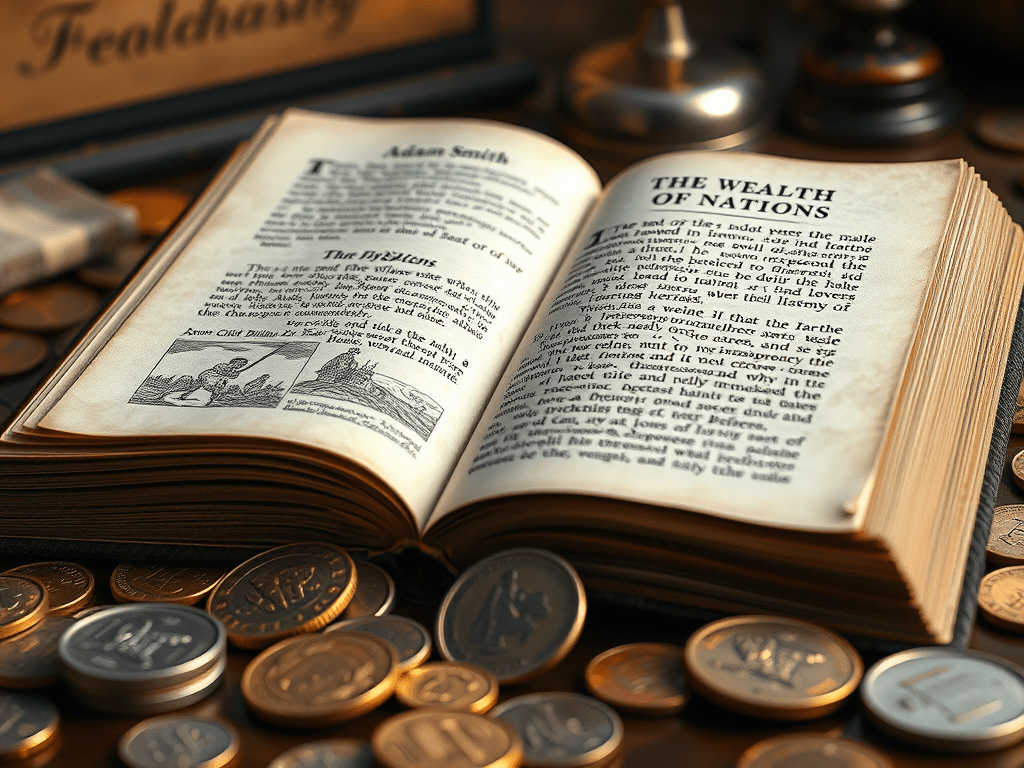
“Labour was the first price, the original purchase money that was paid for all things. It was not by gold or by silver, but by labour, that all the wealth of the world was originally purchased; and its value, to those who possess it, and who want to exchange it for some new productions, is precisely equal to the quantity of labour which it can enable them to purchase or command”
Adam Smith, Wealth of Nations
Wealth of Nations by Adam Smith is arguably one of the most important works published during the Scientific Revolution / Renaissance / early modern era, where European countries experienced one of the fastest periods of scientific and economic growth.
I have been reading the Wealth of Nations more recently, and I am very impressed by the level of insights / intelligence that is delivered by an economist who lived hundreds of years ago. I would say the level of insight / intelligence delivered by Adam Smith is no less than that from any contemporary economists today. The book goes into deep discussion division of labor, detailed documentation of commodities prices (as well as a thorough discussion of their drivers), inflation, among other topics. It is a very long text, and some of the ideas presented can be quite complicated, especially when the historical context is different from that of today. Still, I think anyone serious about economics and finance can gained tremendously from reading this text.
Among one of the most important concepts being discuss in the book – from my perspective – is how inflation happen (and hence the importance of investing in assets that will see a growth in real – instead of just nominal – price.)
Source: script.org
So how does inflation during old times? Hundreds of years ago, currencies / coins was made up of certain amount of gold / silver (recall it was only until 1930 when the gold standard was abolished in the US). In order to increase the amount of currency supply (in order to do more purchase) with the fixed amount of previous metals, what emperors / queens would do back then was to consistently reduce the amount of gold / silver that was injected into a certain coin. By doing that, the royalties can spend more with a fixed amount of gold / silver; however, what in fact happened overtime is that the same coins would theoretically worth less (ie. be able to purchase a lower amount of labor) overtime (because of the lower gold / silver content). In additional, the increase in supply of gold / silver could also reduce the real value of these precious metal overtime (though often time more than offset by the increase in demand). These two effect (i) the reduced amount of silver in a coin and ii) the increase supply of silver – all else equal — driving down the real value of silver) combines to drive inflation.
For me, it is quite impressive to see how inflation (and hence the reduction in value of fiat currencies) can happen even in ancient time.
So the moral of the story seems to be that holding fiat currency is a guaranteed way to lose real value – whether in ancient times or in modern times. Identify assets that are scarce (and preferably will experience a growing demand), and that is the way to preserve or even multiple real value. There are quite a lot of wisdom in Wealth of Nations, and I look forward to share more about my takeaway in separate articles.
 Books Bucks & Beyond
Leave a comment