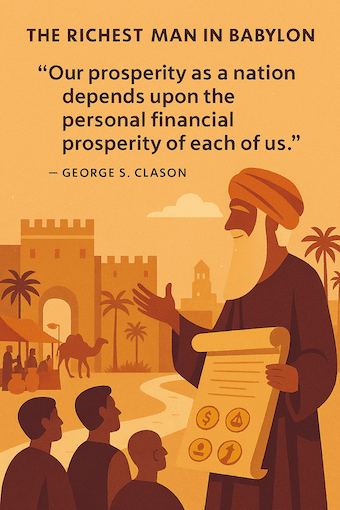
🏺 The Day I Learned Wealth Could Be a Story, Not a Spreadsheet
I’ve read plenty of finance books that felt like instruction manuals — useful, but dry. The Richest Man in Babylon was different. I first encountered it not in a business section, but in a friend’s living room, sitting on a coffee table between a novel and a travel guide.
Opening it felt like stepping into another world: dusty streets, bustling markets, merchants haggling over goods. Yet, beneath the ancient setting, George S. Clason’s parables carried lessons that felt startlingly modern. It was the first time I realized that money advice could be wrapped in a story — and that stories can make lessons stick.
📚 A 1926 Classic That Refuses to Age
Originally published as a series of pamphlets in 1926, Clason’s work was distributed by banks and insurance companies to teach customers about saving and investing. The book’s enduring appeal lies in its simplicity: short, engaging tales set in Babylon, each delivering a clear financial principle.
Nearly a century later, the advice still resonates. Whether you’re in Hong Kong, London, or Lagos, the fundamentals haven’t changed: spend less than you earn, invest wisely, and seek counsel from those more experienced.

💡 Rule #1: Pay Yourself First — The 10% Principle
The book’s most famous rule is deceptively simple: save at least 10% of everything you earn before you do anything else.
In the story, Arkad — the richest man in Babylon — teaches that wealth begins with disciplined saving. For beginners, this is a game‑changer. It shifts the focus from “I’ll save whatever’s left” to “I’ll save first, spend later.”
When I tried this, I set up an automatic transfer to a separate account the moment my salary arrived. It felt small at first, but over months, the growing balance became a source of confidence — proof that I could build wealth without waiting for a windfall.
💡 Rule #2: Control Your Expenses — Wants vs. Needs
Clason’s characters often wrestle with the temptation to spend on luxuries. The advice is clear: distinguish between wants and needs, and avoid letting lifestyle creep eat into your savings.
For beginners, this isn’t about deprivation. It’s about intentionality. I started tracking my spending for a month and was shocked at how much went to “invisible” purchases — snacks, subscriptions, impulse buys. Cutting just a few of these freed up money for investments without feeling like a sacrifice.
💡 Rule #3: Make Your Money Work — Invest Wisely
Saving alone won’t make you rich. Arkad warns that idle money is like an army without a general — it must be put to work.
In Babylon, this meant lending to merchants or funding ventures. Today, it could be index funds, bonds, or a small business. The key is to seek investments you understand and trust.
My first “Babylonian” move was buying into a low‑cost index fund. It wasn’t glamorous, but watching it grow over years taught me the quiet power of compounding.
💡 Rule #4: Seek Advice from the Experienced
One recurring theme is the danger of taking financial advice from the wrong people. In one parable, a character loses money by trusting a brickmaker with investment tips — a cautionary tale about expertise.
For beginners, this means vetting your sources. I learned to ask: Has this person succeeded in the area they’re advising me on? If not, their guidance might be well‑meaning but costly.
💡 Rule #5: Protect Your Wealth from Loss
Babylon’s merchants knew that risk was part of business, but they also knew to guard against unnecessary loss. Arkad advises avoiding investments that sound too good to be true and ensuring you have a margin of safety.
For me, this translated into diversifying my portfolio and resisting the urge to chase “hot tips.” It’s less exciting than betting big, but far more sustainable.
🪞 How These Ancient Rules Changed My Modern Habits
Before reading The Richest Man in Babylon, I thought saving was something you did when you had “extra” money, and investing was for people with large sums to spare. Clason’s parables reframed both as habits anyone can start — no matter their income.
The storytelling made the rules memorable. I could picture Arkad explaining the 10% principle in a sun‑baked courtyard, or a young merchant learning the hard way about bad advice. Those images stuck with me far longer than any chart or formula.
🌟 What This Book Does Brilliantly
- Timeless principles that apply across cultures and eras.
- Storytelling format makes lessons easy to remember.
- Beginner‑friendly — no jargon, no complex math.
- Actionable rules you can start applying immediately.
⚠️ Where It May Leave You Wanting More
- Lacks modern context — no discussion of inflation, digital finance, or global markets.
- Some readers may find the parable style too simplistic if they want detailed “how‑to” guides.
- Doesn’t address psychological barriers to saving and investing in depth.
🌱 Seeing Wealth as a Garden, Not a Race
What struck me most about The Richest Man in Babylon is its patience. The book doesn’t promise overnight riches. It treats wealth like a garden — something you plant, tend, and grow over time.
That perspective changed how I approach money. I stopped looking for quick wins and started focusing on steady growth. And just like a garden, the earlier you plant, the more shade and fruit you’ll enjoy later.
In a world obsessed with speed, Clason’s ancient city reminds us that the slow, steady path is often the surest — and that the richest man isn’t the one who earns the most, but the one who keeps and grows what he earns.


Leave a Reply