🎯 The Lesson That Stuck With Me
When I think back on Morgan Housel’s The Psychology of Money, one idea towers above the rest: the importance of small bets.
Housel describes how seemingly minor experiments can lead to massive outcomes — if you make enough of them and give them room to grow. He shares examples like Netflix’s CEO lamenting that the company wasn’t “failing enough,” meaning they weren’t experimenting enough to discover the next big thing. Or how many of Google’s signature products — Gmail, Google Maps — came from engineers tinkering on side projects outside their core work.
The point is simple but profound: big wins often come from small, low‑risk moves that compound over time.
🧠 Why Small Bets Matter More Than We Think
In finance, we often talk about diversification — spreading investments to reduce risk. Small bets are diversification applied to life.
Each small bet is a test. It might be a new skill you try, a side project you launch, a conversation you initiate, or a modest investment you make. Most will fail quietly. But the few that succeed can change everything.
Housel’s insight reframes failure as a necessary ingredient for success. If you’re not failing occasionally, you’re probably not experimenting enough — and without experiments, you miss the chance to stumble into something extraordinary.
📈 The Asymmetry of Outcomes
What makes small bets so powerful is their asymmetry:
- Downside: Usually limited — you lose a little time, a small amount of money, or some ego.
- Upside: Potentially huge — a new career, a profitable business, a breakthrough idea.
In investing, this is like buying a small stake in a startup. Most will go nowhere, but one could become the next Airbnb. In life, it might be attending a random networking event that leads to a partnership you never imagined.
🪞 How This Changed My Thinking
Before reading Housel, I tended to over‑plan and under‑act. I wanted certainty before starting anything. The “small bets” idea made me realize that certainty is overrated — and often impossible.
I began to treat small bets as part of my routine:
- Launching a tiny blog without worrying about perfection.
- Trying a new investment platform with a minimal amount.
- Offering to collaborate on a project outside my comfort zone.
Most of these didn’t lead to dramatic results. But a few opened doors I didn’t know existed — and those few made all the others worthwhile.
🚦 The Green Lights and the Caution Signs
Housel’s framing of small bets is liberating. It encourages action without recklessness, creativity without the pressure of perfection. It’s a reminder that you don’t need to overhaul your life overnight — you just need to keep placing chips on the table in different spots.
The caution? Small bets still require intention. Scatter them too randomly and you risk spreading yourself thin. The magic is in making small bets that align with your curiosity, values, or long‑term interests.
📚 Beyond Small Bets — The Book’s Other Big Ideas
While the small bets concept resonated most with me, The Psychology of Money is rich with other insights:
- Everyone’s financial story is different — Your decisions are shaped by your unique experiences, so copying someone else’s plan without context can backfire.
- Luck and risk are invisible partners — Success often involves being in the right place at the right time, and risk can undo years of progress.
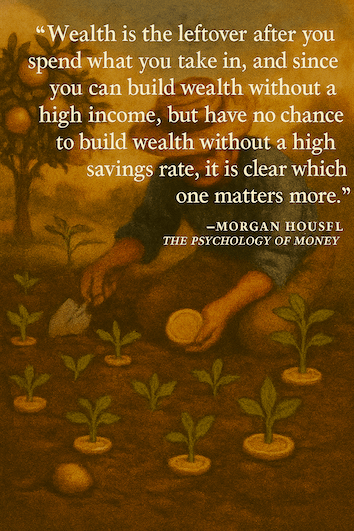
- Saving beats chasing high returns — Wealth is built more by controlling spending and saving consistently than by hitting investment home runs.
- Reasonable > Rational — The best financial plan is one you can stick to emotionally, even if it’s not mathematically perfect.
- Define “enough” — Without a clear sense of what’s sufficient, you risk turning money into an endless treadmill.
These ideas complement the small bets philosophy: they remind us that behavior, humility, and self‑awareness are as important as strategy.
🌱 The Invitation to You
Here’s the question Housel’s book left me with — and the one I’ll leave with you:
What small bets are you making right now?
Not the big, life‑changing decisions — those are rare. I mean the modest experiments, the side projects, the conversations, the skills you’re dabbling in. The things that might fail quietly but could, just maybe, pay off in a way that changes your trajectory.
Because if there’s one truth The Psychology of Money makes clear, it’s this: you don’t need to predict the future to win. You just need to give yourself enough chances for luck, creativity, and compounding to work in your favor.


Leave a Reply